

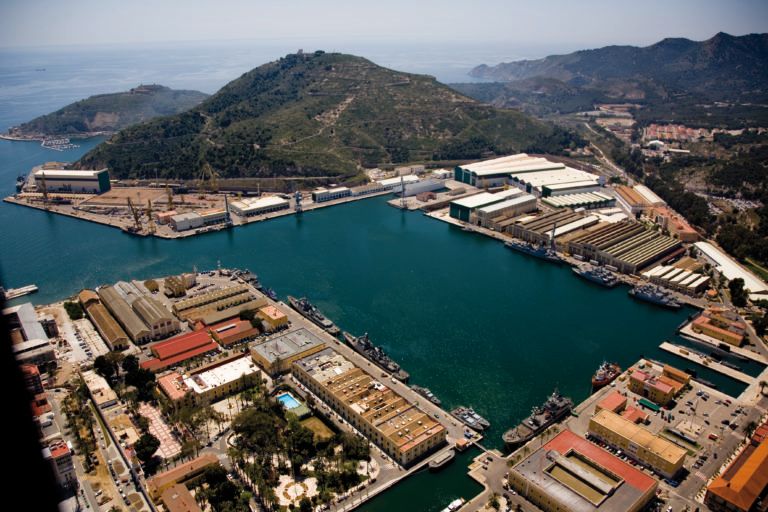
Procurement data published by Navantia between 2021 and the first half of 2026 reveals a broad and stable industrial ecosystem, with a group of Cartagena-based companies playing a central role.
When people think of the Cartagena shipyard, the S-80 submarines usually come to mind first. Yet behind every naval programme lies a network of suppliers handling a wide range of tasks: maintaining cranes and machinery, repairing engines, producing parts to demanding tolerances, servicing electrical installations, building steel structures and refurbishing the site’s workshops and buildings.
This network can be traced through the monthly lists of contracts and orders the state-owned company publishes on its transparency portal. One caveat applies: these lists combine contracts, minor contracts, framework agreements and orders derived from them, so adding up the amounts would not accurately reflect each company’s weight. What they do show is which suppliers appear again and again, and what role they play.
Maintenance: the work that keeps the yard running
Local presence is especially strong in facility maintenance. Two Cartagena firms, Mecánicas Bolea, with expertise in industrial assembly, mechanics and boilermaking, and Integralia Energía, which specialises in electrical and industrial systems, work together through a joint venture that has received orders continuously since 2023. In 2026 their work remains tied to the Cartagena Dock.
They are joined by the Elecnor group, which this year is among the contractors awarded comprehensive maintenance of the Dock, covering cranes, industrial equipment and electrical installations directly linked to production. Other firms in this area include Electrosam, focused on Dock facilities and equipment, and Reparaciones Mecamansol, which handles mechanical maintenance and dry dock related work.
Parts, engines and electrical work
Another less visible but essential group consists of companies that manufacture or restore components. Mecanizados Arocam appears regularly with foundry work, component reconditioning and support for engine assembly, with several orders concentrated during 2025. Mecanizados J.J. Celdrán has supplied custom machined parts for years, an example of a supplier that receives smaller orders but brings very specific capabilities.
In electrical work, Ecoher Industrial y Naval stands out, maintaining an ongoing relationship with the shipyard through framework agreements, with orders documented since at least 2024.
Structures, assembly and infrastructure
The shipyard also needs to keep adapting its facilities. Jumabeda, a Cartagena company, has carried out civil works and building refurbishments within the complex. Trans-Grúas Gipeán works on steel structures and galvanising, while MAESSA Naval handles fabrication and assembly work at the yard during 2025 and 2026.
The supply chain is not limited to local firms. MEISA, based outside Cartagena, works closely with the shipyard’s Engines division and has been involved in piping, structures and, in 2025, the supply of large gantry cranes.
An industrial hub with a future
The shipyard’s capabilities go well beyond building the S-80: it has an engine manufacturing plant, specialised workshops, dry docks, a repair centre and the means to integrate and maintain combat and propulsion systems.
Navantia has also moved to strengthen this environment by opening the Submarine Technology Centre in Cartagena in June 2026. Its goal is to drive research in cybersecurity, robotics and autonomous systems, advanced materials and artificial intelligence, and to reinforce the regional ecosystem around these vessels.
The picture that emerges from the contracts is one of a mature supply industry, with companies that have spent years building technical know-how around one of the city’s main economic engines, contributing long before a submarine reaches the slipway and long after its construction is complete.
Source: Murcia Plaza