

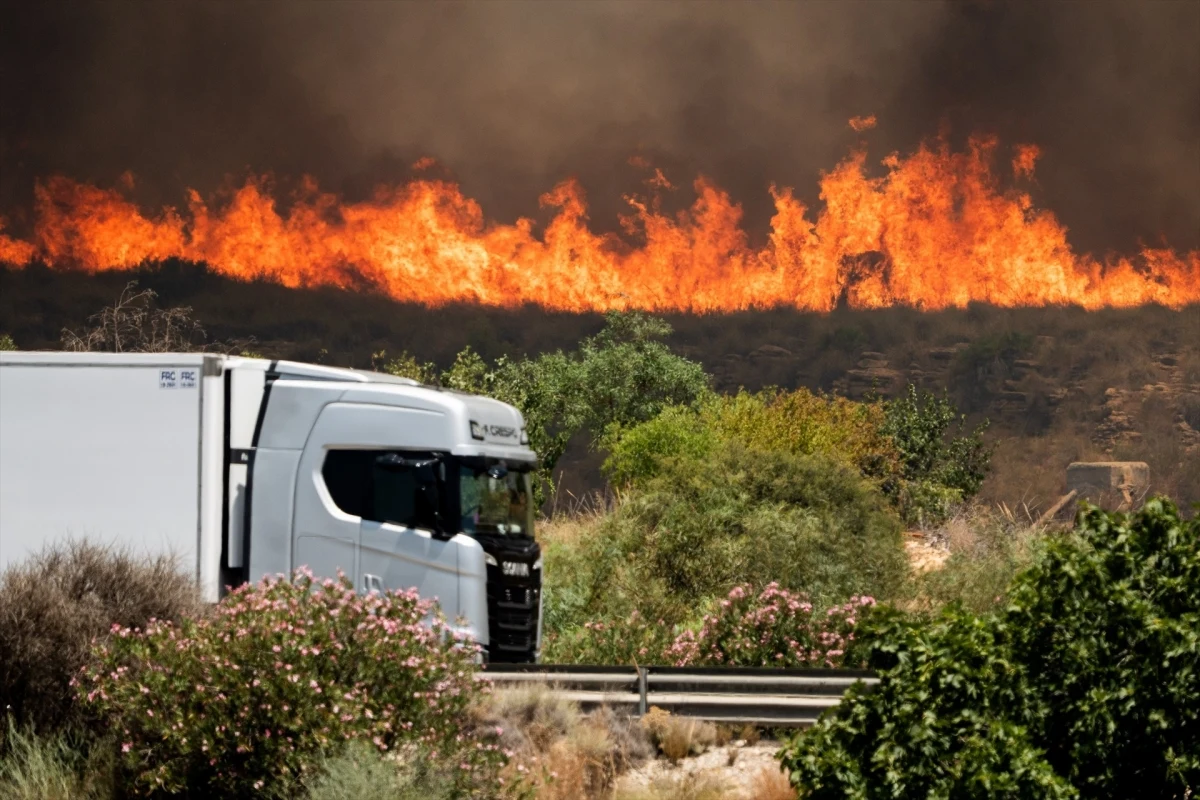
Total safety does not exist. Zero risk is one of the great utopias of modern welfare societies, precisely because their tolerance for suffering is close to zero. With summer here, wildfires are breaking out again — largely through human action or inaction — and two key ideas deserve attention: prevention and dual use.
Almería has just seen a fresh tragedy, where a fire has destroyed hundreds or thousands of hectares of ecosystem and, so far, claimed 13 lives, in part due to improvisation. Crisis response can be split into three phases: the run-up (infrastructure works, training of public services, informing citizens), the moment of the disaster itself (rescues, where emergency services are put to the test), and recovery (returning as close as possible to the starting point).
Natural catastrophes cannot be avoided, but prevention can minimise their damage. The saying goes that crises are resolved before they happen, which makes preparation and training essential — and there is always room to improve emergency and civil-protection services, an autonomous and civilian system whose main tool nonetheless belongs to the central State and is military in nature: the Military Emergencies Unit (UME).
Are you ready for this summer’s contingencies? If you head to a wooded area, a rural or mountainous village, or somewhere near an industrial estate, do you know the evacuation routes, the civil-protection contacts, what to do in a forest fire, a toxic spill, or an extreme weather event? Prevention demands a small effort with an enormous potential return. The successful use of ES-Alert in the Community of Madrid showed this: during the Lozoyuela fire, authorities combined confinement and evacuation effectively — clearing the San Lázaro estate in Buitrago de Lozoya while confining nearby areas — thanks to excellent coordination by the Madrid 112 agency.
The second idea is “dual use”: technologies developed for strategic, military and security purposes that later serve civilian life. Examples include early fire-detection via Earth observation from space — tiny satellites, Synthetic Aperture Radar (SAR) able to image the ground through cloud and smoke, optical and infrared sensors detecting thermal shifts to predict a fire’s direction — plus AI and data analytics for predictive modelling and computer vision to locate trapped people or assess damage to bridges and roads in real time.
There is also a long road to improving command, control and communications through satellite links (SATCOM) and resilient mesh networks that keep telephony and internet running when mobile masts fall. And aerial, marine and ground drones — like those used on the Ukrainian front to recover the wounded, or the marine drones that rescued downed pilots in the Persian Gulf — could retrieve people cut off by fire or save swimmers caught in currents without risking further lives.
In these dramas of fire and earthquake, one idea recurs: no country, group or person can face catastrophe alone. Coordination with partners, allies, friends and neighbours is essential. Valencians learned this painfully during the DANA floods, when the people had to save the people through an army of volunteers. Let us hope that next time finds us with more preparation, planning and prevention — and with our dual-use technology working at full capacity — so we can minimise the material damage, and above all the human cost.
Opinion — by Jesús de Salvador. Originally published in Murcia Plaza.